Friday, October 16, 2015

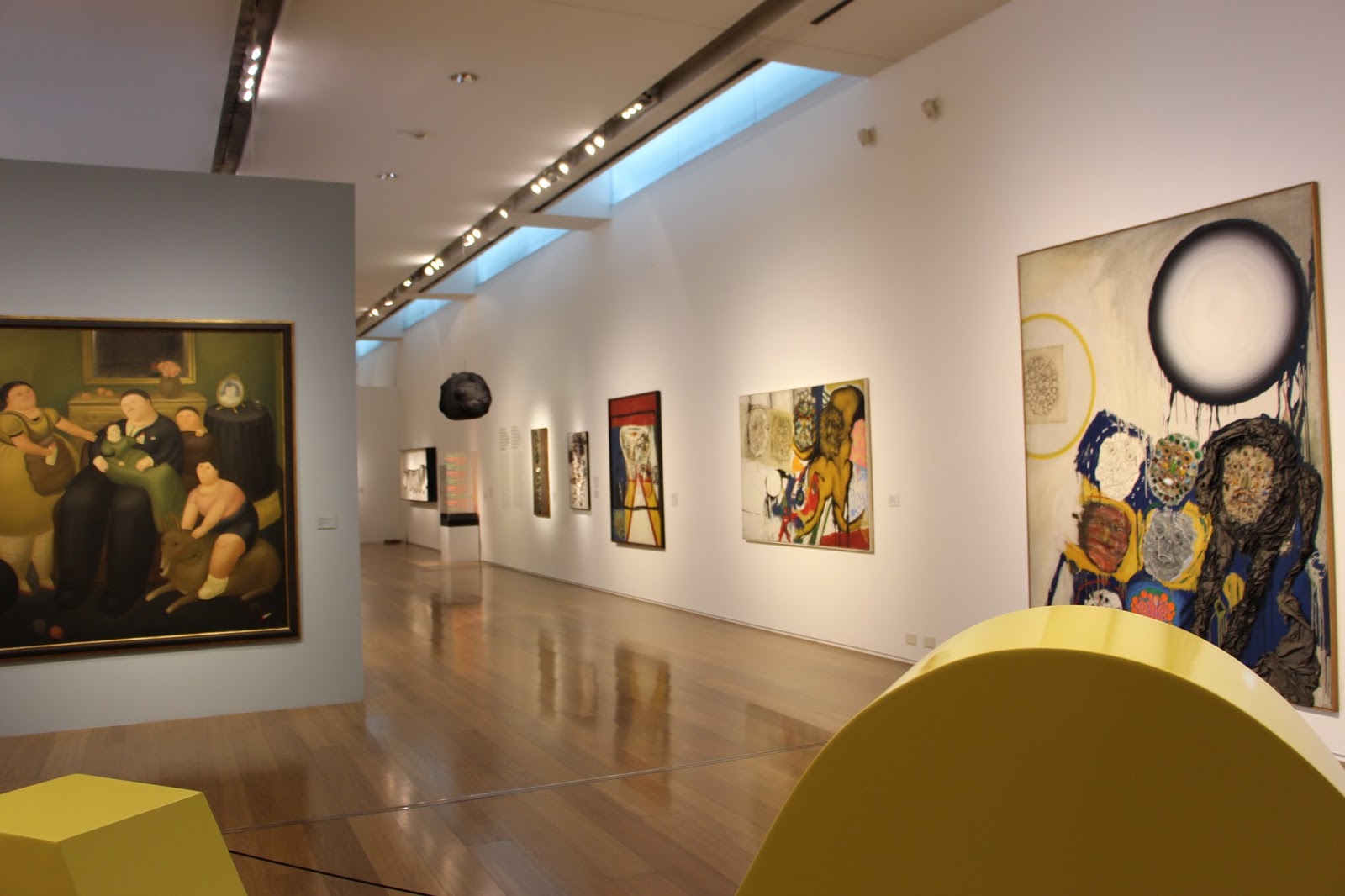
Museum of Latin American Art of Buenos Aires (MALBA)


#SridharPeddisetty, #Argentina, #BuenosAires, #Malba, #Museum, #Travel, #EuropeanArt, #PlacesToVisit, #PointsofInterest
Below are the pictures of taken in Museum of Latin American Art of Buenos Aires (MALBA), Buenos Aires,Argentina


Sunday, October 11, 2015

Museo Nacional de Bellas Artes - Buenos Aires, Argentina

#SridharPeddisetty, #Argentina, #BuenosAires, #MuseoNacionaldeBellasArtes, #Travel, #EuropeanArt, #PlacesToVisit, #PointsofInterest
Below are the pictures of taken in Museo Nacional de Bellas Artes, Buenos Aires, Argentina


Monday, October 5, 2015

Value Stream Mapping As A Process Improvement Tool


#SridharPeddisetty #Agile #PMO #ValueStreamMapping #Lean #Kanban #Value #Stream #Mapping #BestPractices #ProcessImprovement  

“If you can't describe what you are doing as a process, you don't know what you are doing” 
― W. Edwards Deming

What is Value Stream Mapping?

Value Stream Mapping is a lean tool, which employs a flow diagram documenting in detail every step of a process. It is the fundamental tool to identify waste, reduce process cycle times, and implement process improvement.

Why use Value Stream Mapping?

Organizations no longer compete on product or service but they compete on experience of faster to market with quality results. In order to enable Organizations to achieve their strategic objectives, continuous improvement of the quality of products, services or processes must be ongoing. Value Stream Mappings help identify and eliminate source of waste in an Organization's development ecosystem. It is an invaluable technique to define the current state of a process and analyze it for opportunities to reduce time spent on non-value steps. 

How to use Value Stream Mapping?

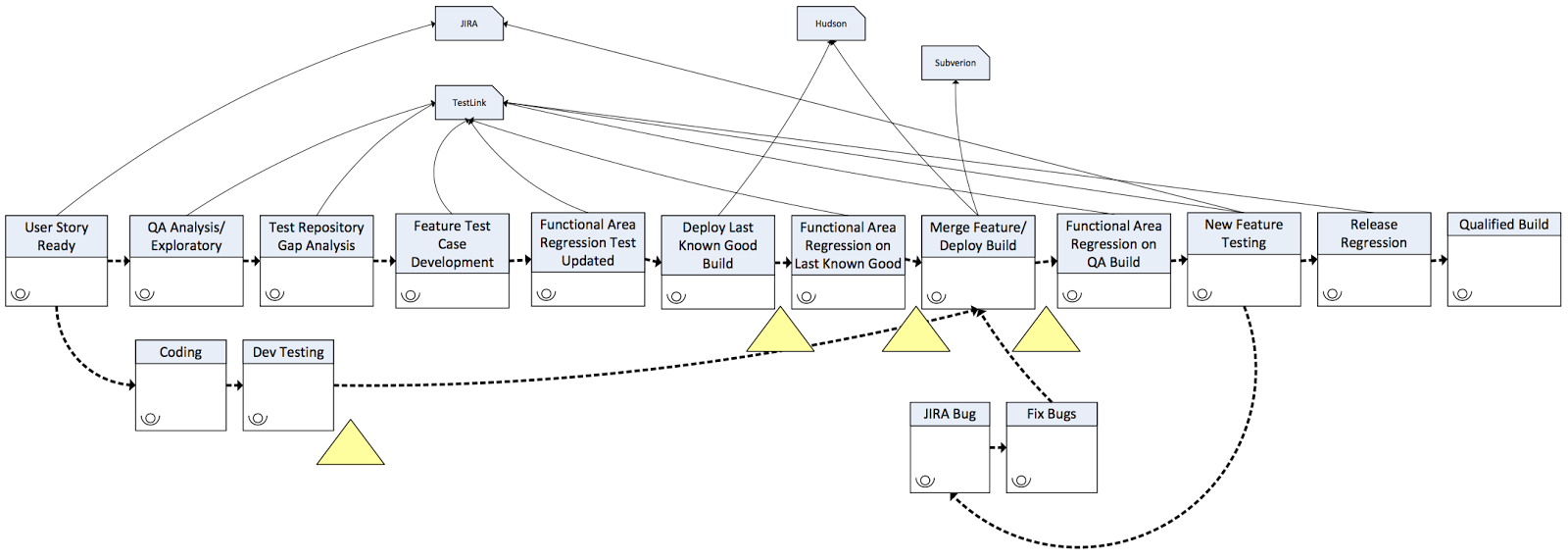
Below is an example of how Value Stream Mapping was employed for identifying the wastes in current ‘As Is Process’ and then eliminating the wastes for improving the overall process in ’To Be Process’. 
In the Figure: ‘As Is’ Process, wastes in the process are marked by a triangle identifying where tasks are taking too long either by redundancy or following unecessary steps. Value Stream Mapping provides an opportunity to identify steps in the process, which provides value to the development process and those that do not. 

                                                        Figure: 'As Is’ Process
In the Figure: ‘To Be’ Process, wastes are eliminated and Value Stream Mapping is applied to create a future state process that reduces total cycle time


                                                      Figure: ‘To Be’ Process

Summary

Apply the method of Value Stream Mapping to an inefficient process within your organization and learn how to calculate the efficiency of a process from end-to-end. Learn to diagram the 'As Is' process to identify areas of waste and then develop the 'To Be' process that reduces total cycle time. An organization's ability to learn, and translate that learning into action rapidly, is the ultimate competitive advantage and Value Stream Mapping is the tool for providing that efficiency in process improvement. 
"Without continual growth and progress, such words as improvement, achievement, and success have no meaning"- Benjamin Franklin
Value Stream Mapping As A Process Improvement Tool was originally posted under Prokarma Blog on Oct 5th 2015

Why Sharing Lessons Learned Is Key For Matured PMO


#SridharPeddisetty #Agile #PMO #LessonsLearned #AgilePMO #ProjectManagementOffice #Project #PMI #BestPractices 

A farmer grew award-winning corn. Each year he entered his corn in the state fair where it won a blue ribbon. One year a newspaper reporter interviewed him and learned something interesting about how he grew it. The reporter discovered that the farmer shared his seed corn with his neighbors.
“How can you afford to share your best seed corn with your neighbors when they are entering corn in competition with yours each year?” the reporter asked.
“Why sir,” said the farmer, “didn’t you know? The wind picks up pollen from the ripening corn and swirls it from field to field. If my neighbors grow inferior corn, cross-pollination will steadily degrade the quality of my corn. If I am to grow good corn, I must help my neighbors grow good corn.”
Farmer is very much aware of the connectedness of life. His corn cannot improve unless his neighbor's corn also improves. So it is with our lives. Those who choose to succeed must help others to succeed. Those who want to live meaningfully and well must help enrich the lives of others, for the value of a life is measured by the lives it touches. And those who choose to be happy must help others to find happiness, for the welfare of each is bound up with the welfare of all. If we are to grow good corn, we must help our neighbors grow good corn. Call it mutualism. Call it a principle of success. Call it a law of life. The fact is, none of us truly win until we all win.
Albert Einstein famously said, "The only source of knowledge is experience" and what better way to gain wisdom from the lessons that we learn while executing projects, programs, portfolios or managing operations. Sharing 'lessons learned' across teams is one of the key aspects of a matured PMO in an Organization. Many of us have not personally experienced the pain of slipping, by stepping on a banana peel, but have learned those lessons through someone elses experiences. 
This is applicable for a matured Organization to have a functional PMO and create an environment of sharing lessons learned across projects, programs or portfolios. Note that 'lessons learned' is not only for documenting failures but also the success stories. The more knowledge shared, the more we gain and lessons learned from successes or failures helps an Organization to leverage on the successes and not repeat failures. For a matured PMO, its an important aspect to share 'lessons learned' on what went well and what did not go well so that an Organization does not repeat past mistakes while following patterns that are proved successful in the past. One template of documenting 'lessons learned' include
  • Document the pre-condition(s) and condition(s) in which the negative (issue) or positive event (best practice) occurred 
  • Describe how the issue arose and define the problem or positive event encountered, and
  • Provide concrete, practical solutions or recommendations based on this experience.
and can be then tagged under 'Lessons Learned Knowledge Base’, which could be managed by PMO. 
"Those people who develop the ability to continuously acquire new and better forms of knowledge that they can apply to their work and to their lives will be the movers and shakers in our society for the indefinite future.” -Brian Tracy

Why Sharing Lessons Learned Is Key For Matured PMO was originally posted under Prokarma Blog on Oct 5th 2015

Sunday, September 20, 2015

Graffitis of Buenos Aires Subway

#SridharPeddisetty, #Argentina, #BuenosAires, #BuenosAiresSubway #Graffiti, #Travel, #TravelPhotography, #PlacesToVisit, #PointsofInterest

Below are the pictures of various graffitis seen in Buenos Aires Subway. 


For more travel pictures visit my Instagram page