Showing posts with label Value Stream Mapping. Show all posts

Tuesday, May 3, 2016

Being Agile: Applying Common Sense With An Uncommon Level Of Discipline


#SridharPeddisetty #Agile #Scrum #Motivational #ProjectManagement #Management #AgileBestPractices #Inspirational  

It takes roughly 10,000 hours of practice to achieve mastery in a field 
- Malcolm Gladwell in his book Outliers

Agile is applying common sense with an uncommon level of discipline. Its a journey of continuous improvements with the openness in providing an environment in which one can learn, unlearn and relearn.  

Below are some of my common sense tips in applying Agile philosophy with an uncommon level of discipline 

#1. Prepare for a marathon: 

While applying Agile philosophy in delivering services, prepare for a marathon and not just a sprint. Its important to ensure clarity about the end objectives and lead the Agile team to show great commitment for the same. Both Pigs (those committed) & Chickens (those involved) should base their decisions on a long term strategic objectives instead of always just tunnel focussed on sprint goals.  Agile philosophy comes good when it is motivated by authority while fostering an environment of collaboration, which is constructive, open & respectful.  

#2. Ensure authentic communication: 

Authentic communication is key for creating an environment, which allows to bring impediments to the surface by having more engaged employees. It allows to create a culture in which team can afford to stop to fix the problems and get the quality right, the first time itself. In my earlier post Looking At An Impediment From A Value Perspective, I had shared how when faced with an impediment, one can enlarge the vision of looking at the impediment from the perspective of delivering value. 

#3. Build a culture of learning from doing:

In an Agile environment, which is driven by cross functional teams & innovations, learning from doing is key. Just the lip service of doing retrospection at the end of sprint is not enough. Build truly a learning culture through relentless reflection (hansei) and continuous improvement (kaizen). In my earlier post Value Stream Mapping As A Process Improvement Tool, I had shared how Value Stream Mapping can be used as a tool for identifying inefficiencies in the processes within your organization.  


#4. Do not have the “Ants in the pants” attitude:

The “Ants in the pants” attitude can be a problem with the beginner practitioners of Agile where the expectations are wrongly set to start seeing immediate results. Practice the ‘Rolling Wave’ adaptive planning to achieve the results and keep your expectations realistic. Keep in mind that an empirical approach generally yields better results than a perspective one. Its important to define some milestones and measure the success based on those milestones. 

#5. Practice Agile with a purpose more than need:

Purpose is more important than need. In the chase between lion and deer, many times deer wins. One reason could be because lion runs for food, while deer runs for life. While practicing Agile, its important to practice with an understanding of the purpose of outcome or output in context of solving business problem. Most of the Agile practitioners do not use governance well enough for monitoring and controlling the project. 

Summary

Discipline is the deciding factor to ensure transparency and accountability is promoted through Agile philosophy. In my earlier post An Agilist Needs More Than Training To Succeed, I had shared that getting trained in Agile does not necessarily mean that we have started thinking ‘Agile’. After training, work in your Org towards bringing in changes including predictable delivery by taking small steps in developing an environment, which fosters a collaboration culture with a shared vision across the Org. This change would require an uncommon level of discipline. 

Please share your experiences on the uncommon level of discipline you follow while practicing Agile. 

Thursday, April 21, 2016

Silence The Mind To Think Clearly & Deliver Results


#SridharPeddisetty #Agile #Scrum #Motivational #ProjectManagement #Management #AgileBestPractices #Inspirational  
Once there was a farmer who discovered that he had lost his watch in the farm. It was not an ordinary watch because it had sentimental value for him. After searching the hay for a long while, he gave up and sought help of a group of children playing outside the barn. He promised that the person who finds it would be rewarded. Hearing this, the children hurried inside the barn, went through and around the hay but still could not find the watch. Just when the farmer was about to give up looking for his watch, a little boy went up to him and asked to be given another chance.The farmer looked at him and thought, “Why not? After all this kid looks sincere enough.” So the farmer sent the little boy back in the barn. After a while the little boy came out with the watch in his hand. The farmer was happy and surprised and so he asked the boy how he succeeded where the rest had failed. The boy replied, “I did nothing but sit on the ground and listen. In the silence, I heard the ticking of the watch and just looked for it in that direction.”

A peaceful mind can think better than a worked up mind. Using the metaphor, a focused project team more often than not, delivers a project successfully. Project team must remain focused on managing value based project goals and stakeholders instead of simply concentrating on budget and scheduling. Below 5 tips can be used for a project team to remain focused 

#1. Be clear on the project value: Project delivery is not just about achieving agreed scope, schedule or cost but its about delivering value. Its often seen that project team while remaining focused on current work tasks sometimes remain oblivious of the value project is going to achieve at the end. In most cases, statement of work (sow) or proposal is authored by individual(s) who would likely not be responsible for actual execution of the project. So its important for the project team to be always aligned with what would be the end value of project. Project team needs to have a complete ‘buy-in’ into the value for them to appreciate their current work tasks. 

#2. Break plan into achievable milestones: We all understand that for every journey we embark, milestones helps us remain focused. Milestones are the small steps, which leads project team to the ultimate project goal whether it be developing of new product or service. Measurable milestones help the project team remain focused and celebrate their achievements along the journey, which goes a long way for a motivated team. Milestones also help team in executing, checking, planning and acting while keeping tab on quality to ensure alignment with the overall project goal. 

#3. Prioritize impediments mapped with value: In my earlier post Looking At An Impediment From A Value Perspective, I had shared  how when faced with an impediment, enlarge your vision of looking at the impediment from the perspective of delivering value. Matured project teams view the impediments as tasks, which needs to be completed for respective user stories and the tasks could be updated and prioritized for the value. As a Scrum Master or Project Manager, one needs to know how things get done in the organisation and who to speak to when faced with an impediment. 

#4. Separate people from the problem: It is very easy to get overwhelmed with frequent pressures of delivering value and thats when things can get defensive for the team. In my earlier post You Already Have ‘NO', Go For ‘YES’, I had shared how its important to keep emotions under check while delivering and always keeping in mind to respond and not to react.’My side of the boat is not leaking’ attitude does not help so its important to separate people from the problem and be rational in identifying solutions for the impediments or dependencies. 

#5. Look for continuous improvements: In my earlier post Value Stream Mapping As A Process Improvement Tool, I had shared how "Value Stream Mapping” can be applied as a tool for identifying inefficiencies in the processes. Retrospections are also key in identifying opportunities for continuous improvements. Note that singular way of doing retrospections does not necessarily fit culture of all organizations so its very important to customize how the feedback is taken and loop for the continuous improvement is applied.

Summary
Similar to how important it is to allow yourself a few minutes of silence to think sharply, project team needs to be focused for successful delivery of project value. 

Please share your thoughts on how you manage to keep yourself focused. 

Previous posts you might be interested in

Monday, October 5, 2015

Value Stream Mapping As A Process Improvement Tool


#SridharPeddisetty #Agile #PMO #ValueStreamMapping #Lean #Kanban #Value #Stream #Mapping #BestPractices #ProcessImprovement  

“If you can't describe what you are doing as a process, you don't know what you are doing” 
― W. Edwards Deming

What is Value Stream Mapping?

Value Stream Mapping is a lean tool, which employs a flow diagram documenting in detail every step of a process. It is the fundamental tool to identify waste, reduce process cycle times, and implement process improvement.

Why use Value Stream Mapping?

Organizations no longer compete on product or service but they compete on experience of faster to market with quality results. In order to enable Organizations to achieve their strategic objectives, continuous improvement of the quality of products, services or processes must be ongoing. Value Stream Mappings help identify and eliminate source of waste in an Organization's development ecosystem. It is an invaluable technique to define the current state of a process and analyze it for opportunities to reduce time spent on non-value steps. 

How to use Value Stream Mapping?

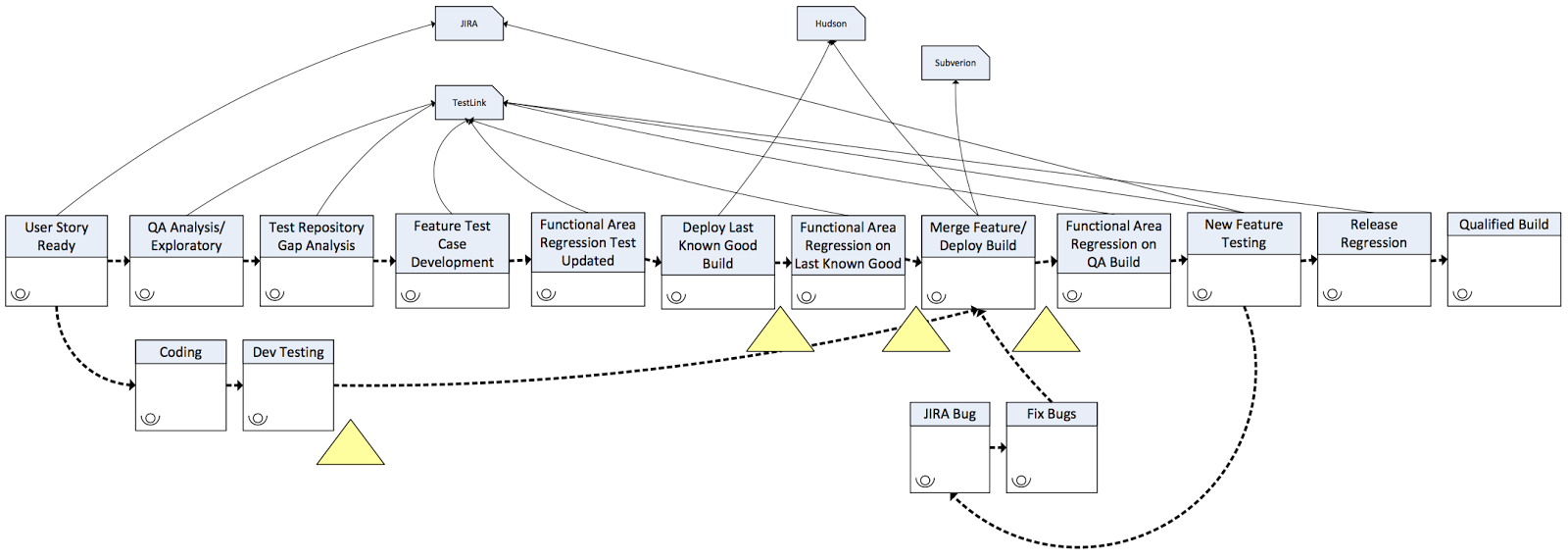
Below is an example of how Value Stream Mapping was employed for identifying the wastes in current ‘As Is Process’ and then eliminating the wastes for improving the overall process in ’To Be Process’. 
In the Figure: ‘As Is’ Process, wastes in the process are marked by a triangle identifying where tasks are taking too long either by redundancy or following unecessary steps. Value Stream Mapping provides an opportunity to identify steps in the process, which provides value to the development process and those that do not. 

                                                        Figure: 'As Is’ Process
In the Figure: ‘To Be’ Process, wastes are eliminated and Value Stream Mapping is applied to create a future state process that reduces total cycle time


                                                      Figure: ‘To Be’ Process

Summary

Apply the method of Value Stream Mapping to an inefficient process within your organization and learn how to calculate the efficiency of a process from end-to-end. Learn to diagram the 'As Is' process to identify areas of waste and then develop the 'To Be' process that reduces total cycle time. An organization's ability to learn, and translate that learning into action rapidly, is the ultimate competitive advantage and Value Stream Mapping is the tool for providing that efficiency in process improvement. 
"Without continual growth and progress, such words as improvement, achievement, and success have no meaning"- Benjamin Franklin
Value Stream Mapping As A Process Improvement Tool was originally posted under Prokarma Blog on Oct 5th 2015