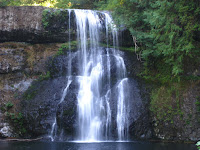
These snaps are of Silver Falls State Park, which we revisited in the month of September. In my earlier post, we shared snaps taken in the month of May. In our last visit we could not get to see Upper North Falls since the way was closed due to unsafe passage but this time we could and that was the only high point of the trip. South Falls and North Falls had considerably less quantum of water falling in September. I have included snaps of South Falls taken in the month of May and September from two different views. First view compares this snap taken in September with this snap taken in May and Second view compares this with this. Similarly with North Falls, where this snap taken in September is compared with this taken in May. So probably the best time to visit is in May when rain is taking a break and sun is looking to smile in Oregon or probably in Fall season when the colorful leaves makes up the scenery more spectacular.


Sharing knowledge on Enterprise Agile Transformation [Strategy, Continuous Delivery, Automation, Best Practices], Agile Methodologies [Scrum, Kanban, Lean, Scrumban, XP], DevOps, PMO, Leadership, Management, Security, Project Management Institute (PMI)'s credentials [Portfolio Management Professional (PfMP®), Program Management Professional (PgMP®), Project Management Professional (PMP®), Agile Certified Practioner (PMI-ACP)], Stanford Certified Project Manager (SCPM) & Travel Tips
Showing posts with label Waterfall. Show all posts
Sunday, September 14, 2008
Sunday, July 6, 2008
Ramona Falls, Oregon
These snaps are of Ramona Falls, Oregon taken in the summer of 2008. Trail of Ramona Falls is of moderate difficulty. Trial is approximately 7.5 miles long and has some spectacular views on its way. There are a few great views of Mount Hood on the way up as well as nice forests. The destination of this trail is Ramona Falls, which is an amazing spectacle within itself. it is so serene and quite and one can easily hear the music of water. Its one of the best waterfall we have seen and the tedious walk was all worth it. Ramona Falls Trail follows the Sandy River and at one point a small bridge is used for crossing the river.


Labels:
Mount Hood,
Oregon,
Portland,
Ramona Falls,
Sandy River,
State Park,
Trial,
USA,
Waterfall,
Waterfalls
Sunday, June 22, 2008
Certified Scrum Master
This post is about Certified Scrum Master. Agile project management is as radically different from traditional project management as agile processes are different from traditional methodologies. Rather than plan, instruct and direct, the agile project manager facilitates, coaches and leads. This person is called a ScrumMaster in the Scrum agile process to denote the difference and remind the person filling this role of the new responsibilities.Accepted participants learn how to be a ScrumMaster and how to make a development team, a project, or an organization agile. Exercises, case studies, and examples used to bring home the realization of how to be a ScrumMaster instead of a project manager.
Scrum Certification is about attending a two-day course, which gives participants hands-on experience using Scrum. Participants gain practical experience working with Scrum tools and activities such as the product backlog, sprint backlog, daily Scrum meetings, sprint planning meeting, and burndown charts.
Following successful completion of the course, each participant will be designated Certified ScrumMaster. This certification includes a one-year membership in the Scrum Alliance, where additional ScrumMaster-only material and information are available.
Scrum Certification is about attending a two-day course, which gives participants hands-on experience using Scrum. Participants gain practical experience working with Scrum tools and activities such as the product backlog, sprint backlog, daily Scrum meetings, sprint planning meeting, and burndown charts.
Following successful completion of the course, each participant will be designated Certified ScrumMaster. This certification includes a one-year membership in the Scrum Alliance, where additional ScrumMaster-only material and information are available.
Labels:
Agile,
Certified Scrum Master,
CSM,
Methodologies,
Scrum,
Scrum Alliance,
Scrum Process,
Waterfall
Scrum References
Following are some of the Scrum References
What is Agile Software Development
According to the definition in Wiki
Agile software development is a conceptual framework for software engineering that promotes development iterations throughout the life-cycle of the project
Agile is a set of processes for software development, that uses iterative, incremental techniques and relies on self organizing, self managing, cross functional teams.
Software developed during one unit of time is referred to as an iteration, which may last from one to four weeks. Each iteration is an entire software project: including planning, requirements analysis, design, coding, testing, and documentation. An iteration may not add enough functionality to warrant releasing the product to market but the goal is to have an available release (without bugs) at the end of each iteration. At the end of each iteration, the team re-evaluates project priorities. Agile methods emphasize working software as the primary measure of progress. From a product perspective, agile methods are more suitable when requirements are emergent and rapidly changing.
Companies are moving to agile processes because the technology marketplace demands its suppliers be highly responsive to change. In order to compete in the global economy, companies must move quickly to provide solutions to a client base that has more and more choices available to them. Agile approaches promise faster delivery of working code, higher quality, and an engaged development team that can deliver on its commitments. Traditional waterfall, with its long phases and heavy investment in “big up-front design,” lacks the flexibility to swiftly respond to the market.
Agile is a different way to work, one that requires greater communication and cooperation from its participants and greater leadership from its managers.
10 Key Principles Of Agile Software Development
In relation to these areas a number of key success factors have been identified (Cohen et al.)
The culture of the organization must be supportive of negotiation
Some of the principles behind the Agile Manifesto are:
Both agile and traditional development recognize the triple constraint: cost, schedule, and scope. But whereas traditional development advocates locking down the requirements so that schedule and cost can be estimated, the agile approach says that scope is always changing and therefore schedule and cost should be fixed. This way projects don’t become death marches, and the product is developed in a fashion where it’s in a perpetual releasable stat
Agile means completely new environment where the team makes decisions instead of being told what to do. It means more individual responsibility for team members, and more facilitation skills required for the project manager
Agile software development is a conceptual framework for software engineering that promotes development iterations throughout the life-cycle of the project
Agile is a set of processes for software development, that uses iterative, incremental techniques and relies on self organizing, self managing, cross functional teams.
Software developed during one unit of time is referred to as an iteration, which may last from one to four weeks. Each iteration is an entire software project: including planning, requirements analysis, design, coding, testing, and documentation. An iteration may not add enough functionality to warrant releasing the product to market but the goal is to have an available release (without bugs) at the end of each iteration. At the end of each iteration, the team re-evaluates project priorities. Agile methods emphasize working software as the primary measure of progress. From a product perspective, agile methods are more suitable when requirements are emergent and rapidly changing.
Companies are moving to agile processes because the technology marketplace demands its suppliers be highly responsive to change. In order to compete in the global economy, companies must move quickly to provide solutions to a client base that has more and more choices available to them. Agile approaches promise faster delivery of working code, higher quality, and an engaged development team that can deliver on its commitments. Traditional waterfall, with its long phases and heavy investment in “big up-front design,” lacks the flexibility to swiftly respond to the market.
Agile is a different way to work, one that requires greater communication and cooperation from its participants and greater leadership from its managers.
10 Key Principles Of Agile Software Development
- Active user involvement is imperative
- The team must be empowered to make decisions
- Requirements evolve but the timescale is fixed
- Capture requirements at a high level; lightweight & visual
- Develop small, incremental releases and iterate
- Focus on frequent delivery of products
- Complete each feature before moving on to the next
- Apply the 80/20 rule
- Testing is integrated throughout the project lifecycle – test early and often
- A collaborative & cooperative approach between all stakeholders is essential
In relation to these areas a number of key success factors have been identified (Cohen et al.)
The culture of the organization must be supportive of negotiation
- People must be trusted
- Fewer staff, with higher levels of competency
- Organizations must live with the decisions developers make
- Organizations need to have an environment that facilitates rapid communication between team members
Some of the principles behind the Agile Manifesto are:
- Customer satisfaction by rapid, continuous delivery of useful software
- Working software is delivered frequently (weeks rather than months)
- Working software is the principal measure of progress
- Even late changes in requirements are welcomed
- Close, daily cooperation between business people and developers
- Face-to-face conversation is the best form of communication
- Projects are built around motivated individuals, who should be trusted
- Continuous attention to technical excellence and good design
- Simplicity
- Self-organizing teams
- Regular adaptation to changing circumstances
Both agile and traditional development recognize the triple constraint: cost, schedule, and scope. But whereas traditional development advocates locking down the requirements so that schedule and cost can be estimated, the agile approach says that scope is always changing and therefore schedule and cost should be fixed. This way projects don’t become death marches, and the product is developed in a fashion where it’s in a perpetual releasable stat
Agile means completely new environment where the team makes decisions instead of being told what to do. It means more individual responsibility for team members, and more facilitation skills required for the project manager
Saturday, May 3, 2008
Multnomah Falls, Oregon, USA
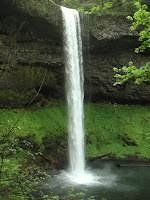
These snaps are of Multnomah Falls Oregon taken in the month of November 2007. Plummeting 620 feet from its origins on Larch Mountain, Multnomah Falls is the second highest year-round waterfall in the United States. Nearly two million visitors a year come to see this ancient waterfall.


Multnomah Falls
Multnomah Falls
Subscribe to:
Posts (Atom)